
One of the first things you encounter when learning to play the guitar is mastering open chords, often called cowboy chords or first-position chords.
These basic chords form the foundation for countless songs, and knowing how to play them is a must-have skill for any beginner guitarist.
They are like the basic Lego bricks, essential for constructing everything from simple to complex structures.
Imagine building a new Lego structure and losing just one piece… (I think we all know that feeling😅)
This is why we do not want to fail at learning these basic chords!
But fear not…
This guide will walk you through what open chords are, introduce you to major and minor chords, and give tips for effective practice!
What are Open/Cowboy/First-Position Chords?
Open chords are chords that use a combination of fretted notes and open strings (hence the name open chords).
They are typically played within the first three frets, which is why they are also called first-position chords.
Known for their rich, full sound these chords are easy to play and widely used in many musical genres, particularly folk, country, and rock music.
The term cowboy chords comes from their frequent use in simple, strummed accompaniment patterns common in country music.
We have two main categories:
- Major Chords
- Minor Chords
Open Major Chords
Major chords have a bright, happy sound.
The name major is related to music theory, but at this stage, you don’t need to worry about that. Just focus on memorizing the shapes and their names.
Here are the most common open major chords (pay attention to the fretboard diagrams for the optimum finger placement):
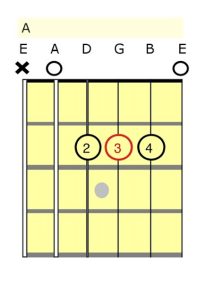
- A Major (A): Played by pressing down the 2nd fret of the D, G, and B strings, leaving the A and high E strings open. The low E string is muted.
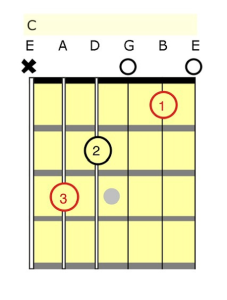
- C Major (C): This chord uses the 1st fret of the B string, the 2nd fret of the D string, and the 3rd fret of the A string, with the G and high E strings open. The low E string is muted.
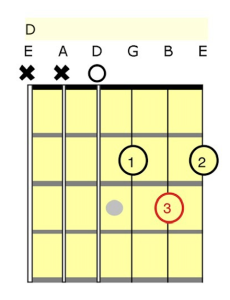
- D Major (D): Played by fretting the 2nd fret of the G and high E strings and the 3rd fret of the B string, leaving the D string open. Both the low E and the A strings are muted.
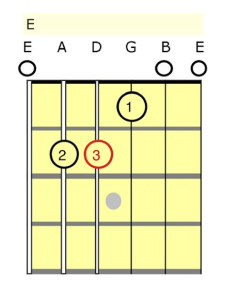
- E Major (E): Uses the 1st fret of the G string and the 2nd fret of the A and D strings, with the low E, B, and high E strings open.
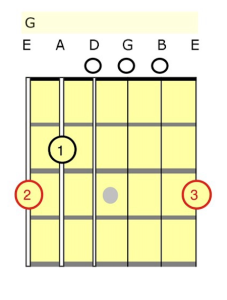
- G Major (G): Played by pressing the 3rd fret of the low E and high E strings, the 2nd fret of the A string, and leaving the D, G, and B strings open.
Minor chords have a more sad, melancholy sound.
Here are the basic open minor chords:
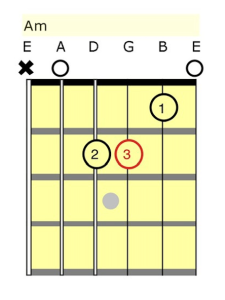
- A Minor (Am): Fretted by pressing the 1st fret of the B string and the 2nd fret of the D and G strings, with the A and high E strings open. The low E string is muted.
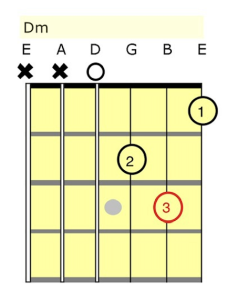
D Minor (Dm): Played by fretting the 1st fret of the high E string, the 2nd fret of the G string, and the 3rd fret of the B string, leaving the D string open. Like the D major, the low E and the A strings are muted.
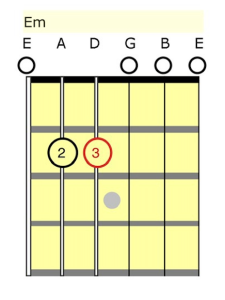
- E Minor (Em): One of the simplest chords, played by pressing the 2nd fret of the A and D strings, leaving the G, B, high E, and low E strings open.
Chord Progressions to Practice
Practicing chord progressions is a great way to get comfortable with transitions between chords.
Actually, I encourage my students to memorize the various shapes by practicing simple chords into context (progressions).
Here are some simple yet effective progressions to start with:
- A | D | E: Found in many blues and rock songs.
- Am | Dm | G | C: Common in numerous jazz and rock songs.
- C | G | Am | F: A common progression in pop and rock music.
- G | D | Em | C: The same as above but in a different key (G).
These progressions are typical harmonic chains used in countless songs.
Practice Tips
- Start Slow: Begin by strumming each chord slowly, ensuring each string rings clearly.
- Stay Relaxed: Tension is our enemy. It can make playing more difficult and cause injuries. Keep your hands and fingers relaxed. It’s expected to have some tension when you practice something new. Slow down and practice at a comfortable tempo. As you practice more, your body will naturally find ways to make the motions smoother and more relaxed. Then, you can gradually increase the tempo. Always pay attention to your hands and stop if you feel any pain. Consult a medical expert if necessary.
- Consistent Practice: Regular practice is key to building muscle memory and improving your guitar skills, including chord transitions. If tension is our enemy, consistency is our friend!
FAQ: Open Chords for Beginner Guitarists
Open chords are chord shapes that combine fretted notes with open strings. They are usually played within the first three frets of the guitar neck, which is why they are also called first-position chords or cowboy chords.
The term “cowboy chords” comes from their strong connection with simple strummed accompaniment in country, folk, and rock music. They are the chords you can use to play thousands of songs around a campfire—but they are not only for beginners. Great guitarists keep using them throughout their musical journey.
Start with the shapes that are easiest to form and appear in many songs:
-
E minor (Em)
-
E major (E)
-
A minor (Am)
-
A major (A)
-
D major (D)
-
D minor (Dm)
-
C major (C)
-
G major (G)
Do not try to memorize everything in one practice session. Learn one shape at a time, make every note ring clearly, and then connect it to another chord in a simple progression.
Usually, one of three things is happening:
-
Your finger is too far away from the fretwire.
-
Your finger is accidentally touching a nearby string.
Place your fingertip close behind the fretwire—not on top of it—and keep the fingers curved. Then pick through the strings one by one. This helps you identify exactly which string is not ringing clearly.
Some fingertip discomfort is normal when you begin playing guitar, especially while you are building calluses. But hand, wrist, thumb, or forearm pain is not something to ignore.
Keep your hand relaxed, avoid squeezing the neck harder than necessary, and take short breaks. Slow down if you notice tension building. If you experience persistent or sharp pain, stop and consult a qualified medical professional.
First, make sure you can form each chord shape correctly. Then practice transitions between just two chords, slowly and in time.
For example, work on A → D, D → E, or G → C before attempting a full progression. Keep your fingers close to the strings, look for fingers that can stay in place, and use a metronome at a tempo where you can change chords without rushing.
Your next step is this guide: How to Change Chords Quickly.
At the beginning, yes. Looking at the fretboard can help you place your fingers correctly and learn the shapes. Over time, try to look away for short moments while changing between chords. This gradually develops your muscle memory and helps you keep your attention on rhythm, listening, or singing.
No. You can play many songs with open chords alone. Learn to make them sound clean and change between them in time first. Barre chords become important later because they give you more freedom across the fretboard and expand the repertoire.
Open chords develop essential skills that every guitarist needs, including finger placement, rhythm, strumming control, and active listening. They are also used across many different styles of music. Even if your ultimate goal is lead guitar, rock, metal, or improvisation, these skills will help you become a more complete musician.
By mastering these chords, you’ll build a solid foundation for your guitar-playing journey.
Whether you’re strumming around a campfire or playing along to your favorite songs, these cowboy chords will serve you well.
But there’s a catch……
Without playing them in time, all these chords are pretty useless.
The core of the music is rhythm. Without rhythm, we have no music ( just notes randomly spaced in time).
And here is the first wall a beginner guitarist hits, wondering…
How can I transition from chord to chord quickly (and therefore in time)?
I’ve got you covered!
Click below to continue to part 2:
How to Change Chords Quickly!